
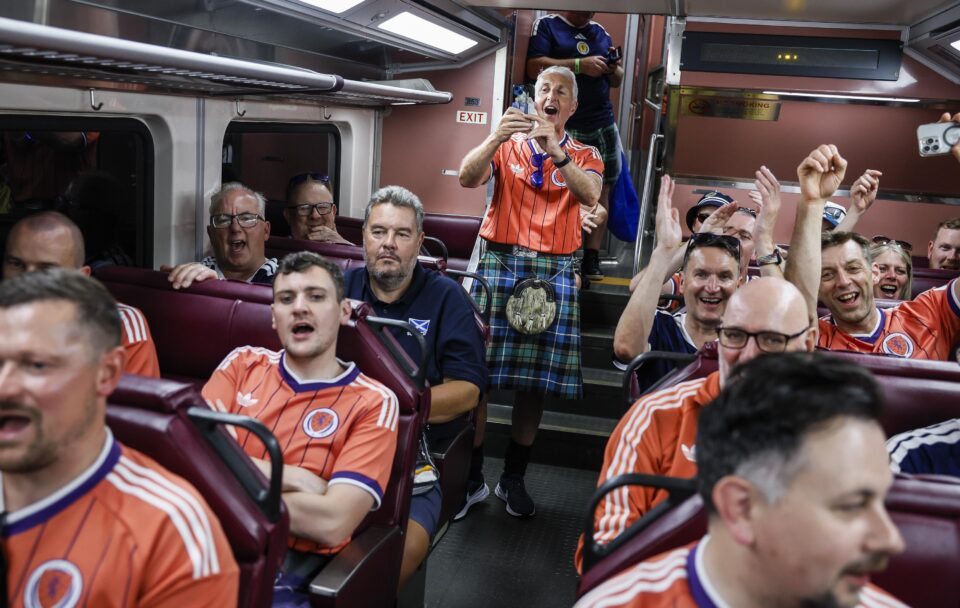
World Cup fans en route to a Scotland vs. Haiti match in Boston. | Erin Clark/The Boston Globe
Much like its indifference toward soccer, America’s aversion to public transport has made it a global anomaly, an oddity encapsulated by the nation’s sacred pre-game pastime: the tailgate.
Here in the US, celebrating sports means driving your big car to a colossal suburban gridiron football stadium, where you’ll grill, baby, grill until the smoky scents of burgers and bratwurst float across vast plains of asphalt. So entrenched is the nation’s car culture that the average American spends about half a month sitting behind the wheel every year. In fact, while the US has tens of millions more cars than it has people to drive them, even its largest cities have far fewer trains or buses per capita than our global peers.
As a result, Americans are more than twice as likely to die in a car accident as Europeans, and nearly five times as likely to die in a car crash as someone in train-happy Germany. While many transit projects carry similar price tags, the US still boasts many dozens more college football stadiums than it does rapid transit systems or subway networks.
View Link
So, it’s no wonder that critics doubted that US cities hosting this year’s World Cup, the largest single sporting event in human history, could effectively find ways to schlep visiting fans around. After abandoning its initial pledges to shepherd fans for free, New Jersey earned scorn for trying to sell $150 round-trip train tickets to MetLife Stadium, prompting journalists to test how difficult it would be to reach it by foot, bike, or canoe. Kansas City’s shiny new pop-up World Cup buses got caught in hours of ensnarled traffic on their way to their city’s very first game, a match-up between Algeria and Argentina.
And yet, on the precipice of the tournament’s final stage, the nation’s widely expected World Cup public transit meltdown has simply not materialized. To the surprise of pretty much everyone, US cities have managed to absorb the influx of fans with relative ease, even under the pressure of record ridership en route to stadiums, watch parties, and fan zones.
Eli Lipmen, executive director of the advocacy group MoveLA, said that he had “actually been pleasantly surprised and quite impressed” with how the Los Angeles transit system performed amid the World Cup. As he explained, that notoriously gridlocked city is in the midst of a “major cultural shift” around public transit. As Angelenos spend less time in their cars, the city has gotten quieter, he said. “People are happier. There’s more of a sense of community.”
A renewed commitment to public transit infrastructure has played a part in that shift — and not just in Southern California. In the lead-up to the World Cup and the 2028 Olympics, Los Angeles unveiled three new subway stations in May, its first new stations to open in over two decades. Meanwhile, Seattle’s Sound Transit shuttled a record-shattering 309,000 riders when Team USA faced Team Belgium, thanks in part to its completion of a light rail extension that had been in the works for nearly two decades. Atlanta overhauled its bus network, Miami made use of a new rapid transit line, and Kansas City spent millions to expand its tram service and rolled out pop-up shuttles.
As it turns out, US cities can build new buses, trams, and trains much faster than they may think. The harder question now is whether they can keep up that momentum when it serves locals, and not just visitors. Just hours after Kansas City’s final World Cup match — Argentina 3, Switzerland 2 — its cash-strapped transit authority shut down its extended tram service with plans to slash a quarter of its regular bus routes by the end of this summer.
Many host cities “are still not building [transit] as a serious modal shift” away from cars, said Eric Goldwyn, director of the Marron Institute of Urban Management at NYU. “They’re building it as a cutesy patootsie complement.”
Americans learned to love soccer. Can they learn to love transit too?
LA is among the exceptions, and not only because of its looming Olympics host gig. The city has made a concerted effort over the past couple of years to invest in and rebrand its transit system, which had long had a reputation for grime and danger. “If you’d spoken to me two and a half years ago, this conversation would be about safety and security on the metro system,” said Lipmen, referencing a bus that was taken hostage in 2024, one of several “really horrible, very high-profile incidents” that left many Angelenos feeling unsafe on the system. “Now, the conversation is about joy and celebration.”
What changed?
LA began investing heavily in building more trains, buses, and subway stations, and overhauled its public safety approach, which led to a 6.7 percent drop in violent crime on transit and a 33 percent drop in incidents like drug use and weapons possession. For Lipmen, the real shift came when the metro system opened its three new stations along the D line in May, and released a raunchy “Ride the D” shirt to celebrate it. Almost immediately, the Metro’s cheeky merchandise sold out, and would continue to sell out every time it was restocked for months to follow.
It might sound silly, but the hype genuinely helped dull some of the stigma associated with taking the train. “People who were quietly riding transit all of a sudden felt comfortable in their own skin as a transit-rider, and proud to be a transit-rider,” said Lipmen.
Overall, LA’s big bet appears to be slowly working. “LA is a transit city,” Jennifer Vides, Metro Los Angeles’s chief customer experience officer, told the Associated Press last week. “People want to try to say that it’s not. Obviously, we have a lot more expansion to do and we’re working on it. But people really want transit.”
Beyond adding new train lines or bus fleets, normalizing public transit requires “a dramatic recast of how people get around and travel,” Goldwyn said. Cities need a vision that ensures that there is an actual “destination on the other end” of their new transit line, like offices or the kind of housing California’s new bill aims to get built near transit hubs. Most cities will need a mixture of “carrots and sticks” to help people who are used to driving everywhere see the value in hopping on a bus or tram as part of their everyday commute, not just to get to the airport or the stadium. “If your transit is not connecting you to places you want to go, you’re not going to use it,” Goldwyn said.
A single tournament, like a single train line, will never be enough to change how Americans move. But if this nation of football fans can learn to love soccer, then surely they can learn to love the train a little bit more too. At the very least, with LA28 precisely two years away, Los Angeles just got closer to making its car-free summer Olympic dreams come true.
