
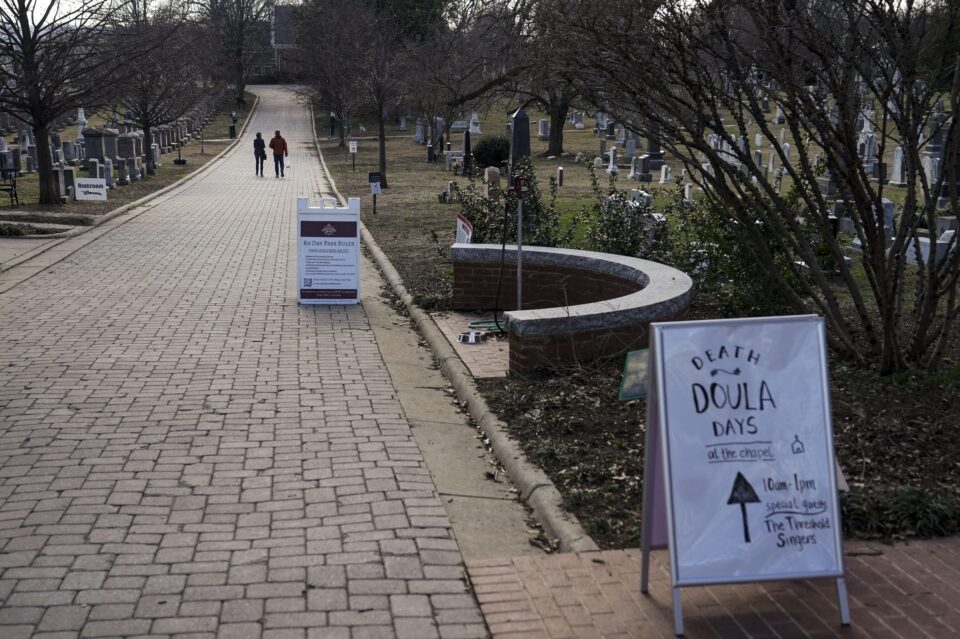
A sign for “Death Doula Days, a weekly program hosted by Laura Lyster-Mensh” is seen near the chapel at the Congressional Cemetery in Washington, DC, on January 7, 2023. | Carolyn Van Houten/the Washington Post via Getty Images
Death doulas, also called end-of-life doulas, wear many hats. In helping patients and their families prepare for a peaceful end of life, they can offer solace and companionship, handle logistics, mediate with medical staff, and more.
As my colleague Anna North reported recently, public interest in the job is growing. Celebrities like actor Nicole Kidman and director Chloé Zhao have spoken about training to become death doulas, and the hospital drama The Pitt recently featured a death doula character.
“The interest from celebrities mirrors interest that we’re seeing from the population as a whole,” North told Today, Explained co-host Noel King. “There’s been a rising interest in death doulas in recent years, especially since the Covid-19 pandemic began, when so many people were forced to encounter death at the same time.”
Noel spoke with North and a death doula, Jane K. Callahan, for a recent episode of Today, Explained.
Callahan, who works in Durham, North Carolina, and wrote A Death Doula’s Guide to a Meaningful End, shared the experiences that made her want to be a death doula, what the job entails, and how the “death-positive” movement encourages us to acknowledge our inevitable demise and prepare for the best death we can imagine for ourselves.
Below is an excerpt of the conversation, edited for length and clarity. There’s much more in the full podcast, so listen to Today, Explained wherever you get podcasts, including Apple Podcasts, Pandora, and Spotify.
Why do you do this work?
In 2009, I got a call that my mother was in the hospital. She would end up dying two weeks later. I was 27 years old. And that was my first exposure to anything involving death and dying. And during those two weeks, I realized how broken this healthcare system is when it comes to helping people die versus fixing them.
I didn’t understand what was happening to my mother’s body, because I had no knowledge of how the body dies. It was hard to get a direct answer from a doctor. In fact, no one told me until toward the end that she was dying. I was waiting for her to be discharged.
I sat with that for a couple of years, and, eventually, I got pregnant, and I had my son. And when I gave birth to my son, I did not have a birth doula. I didn’t really understand what that was. A lot of things went wrong. So, I started researching birth doulas and realized that would’ve really helped. That’s how I found out that there are death doulas, which are based on the birth doula model. I realized those were all the things that were missing in the last two weeks of my mother’s life. So, I attended a training, and I started volunteering with hospice, and I’ve been doing that for eight years.
Do you think that you are more comfortable with death than most people?
I think I’ve gotten comfortable with being uncomfortable, which is really the main skill of being a doula. We’re not untouched by the work we do. I have moments where losing someone I’ve worked with is very hard, and watching them suffer and die is very hard. But you start to accept the reality of it through learning how to sit with discomfort.
Do you think that being in close proximity to death changes the way you think about being alive?
Absolutely. In Bhutanese culture, they’re encouraged to think about death five times a day. Do I think it’s mentally healthy to just spend your entire day every day thinking about death? No, that’s not healthy. It’s also not really possible. But, I think being consistently aware of the fact that we’re not here for very long, and that it can end at any time — today, even — makes you appreciate what you have.
Since I’ve started doing this work, I have found myself being a lot more present in my everyday life and appreciating small things. Definitely more gratitude and more awareness.
I think that one of the many things that freaks us out about death is the finality of it. The sense of, “Oh, I will never see this person again.”
I wonder whether you have ideas about where we go after we die and if there’s something in there that you find comforting.
Yes, but I will say, as a disclaimer, doulas are trained not to answer that question. When a client asks you, “Do you believe in an afterlife?” you should really reflect it back on them and say, “Why is that important to you?”
When someone is scared and unsure, maybe even desperate, they see doulas as a guide, and your answer has an influence. And doulas are not meant to influence people. Doulas are meant to facilitate what someone wants. By sharing my opinion directly with a client about what I believe, there’s potential there to influence them and their journey towards the end of life. And so, I try to steer the conversation away from my beliefs, because, really, what I’m there for is them, and their beliefs, and their values, and goals.
But, I will say, before I started this work, I was a hardcore atheist. I am not anymore. I am not going to pretend I have any idea what happens, but I’ve seen enough in the dying process and in death itself that there’s something I just can’t put my finger on. But I just cannot say that there’s nothing.
What is it that’s making you think that?
You know, when someone is in what we call active dying — which, by the way, can last up to two weeks, dying can be a long process — the person looks different. It’s the same person. Their body’s still working to a different degree obviously, but something looks different. Something feels different.
And there’s a point where someone loses consciousness, and you can just feel, and I know this is not very scientific, but you can just feel like they’re halfway somewhere else. And right before the moment of death, there’s almost like a brightening of the person, kind of like this clarity in appearance is the best way I could explain it.
I don’t want to say glowing, but when you see someone who’s in love, and they just look different — it’s kind of like that. And after they die, in those minutes, their face has not changed at all. They’ve just died, but something looks and feels different.
And do you find that comforting to a degree?
I think there’s always going to be a fear if the light switch turns off and there’s nothing. But I see that as kind of a win-win situation, because if there’s nothing, then I’m not going to know what I’m missing. And if there’s something, then, great.
What’s the best part of this work, and what’s the worst part?
The best part of this work is the huge difference that doulas can make for patients and families at the end of life. Losing someone you love and losing your own life is sad. Sometimes, it’s even tragic, but when a doula is involved early enough in the process, it does not become a trauma. And that is absolutely what is happening to families without death doula care.
“It’s really about giving what control is left in these situations to the dying person. And it’s also about avoiding panic and chaos by thinking ahead and talking these things through.”
The thing that I don’t like about this work is, because there’s not enough awareness of us, because people are referred to hospice way too late, I’m often called at the 11th hour when a family is in crisis, and there’s only so much I can do to help.
That’s hard, because I’m very aware of how differently that could have gone if there had been a more timely referral to hospice, if there had not been high levels of denial.
What would it look like for this, in your view, to be better?
I think that our healthcare system is focused on curing and fixing, and doctors will internalize death as a medical failure. We have to shift how we care for someone when they’ve reached the end of the road. We’re already seeing that shift in the growing presence of palliative care, which is a great field.
As far as working with a doula, doulas are not covered by insurance, Medicare, or Medicaid. And so, that means doulas either work pro bono or offer a sliding scale, or they only serve the people who can afford a doula. And that can exacerbate the division we’re seeing with the haves and the have-nots in having a good death.
Are you able to make a living doing this? Are you pro bono? How does your life work?
I do charge sometimes, if the family has sufficient funds. I don’t charge a lot of the time. And that is a personal choice, and I’m acknowledging I have the ability to do that.
There are people who can make a living off this. I would say that’s mostly possible in large metropolitan areas where there’s a huge number of people. I think that’s far less possible in smaller towns. Only so many people are dying. Only so many dying people know about a doula or want a doula. And only so many of those people can afford one.
What’s it like to get trained as a death doula? Do you end up with a certificate or a degree?
There’s pros and cons to that. Right now, there is no national standard. There are not even state standards for death doula work, and there is no formal or formally recognized licensure. That’s part of why we’re not reimbursed right now.
What you’re seeing is you have a couple of major organizations who offer trainings across the country, and then, increasingly, you’re seeing a lot of death doula schools pop up online.
These courses vary in their content, and their quality, and in how much they cost. Every curriculum has its own content. There are things some curriculums touch on that others may not. Some people will take the training and immediately market themselves as doulas to their community. But there’s no clear pathway to hands-on mentorship, or apprenticeship, or anything like that.
Can you tell me about someone that you’ve worked with, someone who stands out in your mind?
I’ve been doing this for eight years, so, a lot of people. I think there was one family that I learned a lot from, and that’s primarily because they engaged me early enough, which is not as common.
It was two adult children, and they reached out to me. Their mother had terminal cancer. She was still being treated with chemo. She had some other health issues, and her teams were not speaking to each other. She was low income, and there were issues with her housing. There were issues with her being able to get transportation to her chemo appointments. Both of her adult children were working full time. One was dipping into the 401k to pay for mom’s care. Another one took a second job driving Uber at night to pay for mom’s care. And there was tension within the family.
And so, we come in and, as doulas, we can do some of the logistical stuff: Do you have your advanced directives? And then we worked on logistical issues, like “let’s find ways for you to get transportation to your appointments.”
Once she enrolled in hospice — and this is a very common misunderstanding with families — most people get home hospice, which means they die in their own homes, and the hospice team comes to them. Many people think that that means 24/7 care. It does not. A nurse will come to your house, toward the end, one hour a day. The other 23 hours are on the family, who have no caregiver training. And if they don’t have money for that, then there’s a problem.
And then also creating what we call a vigil plan or a death plan. I talked to the dying woman about what kind of environment she would want: “Well, I love country music.” So we made sure we had her favorite country musicians playing. Any kind of scents? She loved roses, so we had a rose candle. She wanted fuzzy socks and a fuzzy blanket. She really liked that feeling for her comfort. We talked about, “do you want to be touched?” “Yes, hold my hand, but don’t touch my feet.”
Some people want all their friends and family coming and going, and laughing, and telling stories, and looking at photos, whereas other people, like this woman, said, “I want my dignity, and when I start going into active dying, I really just want these couple of people around me. I don’t want anyone else coming in and out.”
It’s really about giving what control is left in these situations to the dying person. And it’s also about avoiding panic and chaos by thinking ahead and talking these things through. If I’m having a conversation with you, then you’ve never died before, so you may not know what to think about and what to ask. You don’t know what you don’t know. And doulas who have that experience know how to help you think about planning for the most peaceful death possible.
It’s so cool how much you learn about people. Some people want everybody coming in and out, and talking, and laughing. And other people, I imagine, find that exhausting. People are very different in life. And it is just so cool to hear you talk about how different people are in death, as well.
Yeah, I have my whole death plan. I want lots of plants around me, because I like plants. And then, have you ever been really sick with the flu or cold, and you wake up in the middle of the night ,and there’s no sense of time and it’s just horrible? Well, I want to have Christmas lights, because I associate those with comfort and coziness.
The thing is, it asks us to have an imagination about our own death. And that’s really challenging for some people. And doulas, a skilled doula will be able to help someone open that door at a pace that works for them.
One of the values of doulas outside of patient work is this public education about, “Hey, we do have to think about these things if we want the best for ourselves.” This is the death-positive movement. That’s what it’s referred to. Educate yourself, have these conversations, normalize talking with your parents about what they want at the end of life instead of guessing.
The death-positive movement isn’t asking people to be excited and happy about dying. All it is asking people to do is understand that this is an inevitability. It is part of being a human being. And you can also still be scared, and you can also still grieve the fact that this ends one day. You can have both. And I think I exist in both.
