
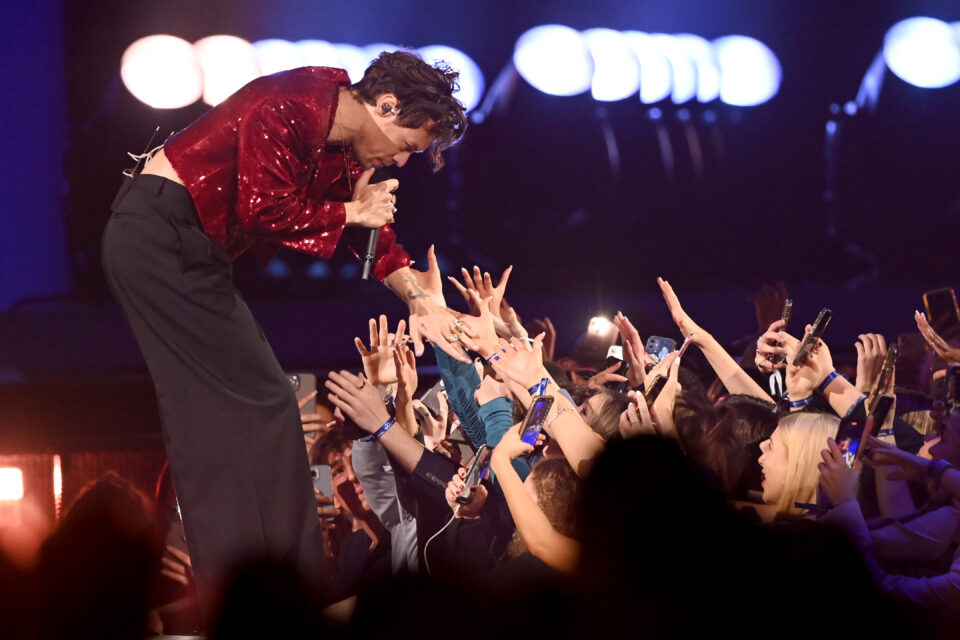
Harry Styles performs on stage during The BRIT Awards 2023 in London, England. Styles’ concert tickets have been going for over $1,000. | Dave J. Hogan/Getty Images
The fans are fighting again. Followers of artists like Harry Styles and BTS reported seeing ticket prices well over $1,000 for seats — and that’s when buying tickets directly, not only resale sites.
The cost of attending a concert has skyrocketed in recent years, making it closer to a luxury purchase than a hobby. We can partially blame the pandemic for jacking up the cost of running a big production. And, as always, we can blame resellers for buying up cheap tickets and selling them back to us for exponentially more.
But the base price of a ticket now looks oddly similar to that inflated resale price. Why? And is there any amount we won’t pay to see our favorite artist perform live?
On Today, Explained, co-host and avid concertgoer Astead Herndon dug into these questions with Taylor Mims, a Billboard editor who covers the live entertainment industry. They discuss the behind-the-scenes costs of touring, why prices won’t come down, and whether a breaking point is on the horizon.
Below is an excerpt of the conversation, edited for length and clarity. There’s much more in the full podcast, so listen to Today, Explained wherever you get podcasts, including Apple Podcasts, Pandora, and Spotify.
I recently read that Harry Styles was charging $1,000 for a concert ticket. No beef with Harry Styles, but that seems like a shocking price. Can you tell me what’s going on here?
$1,000 is a lot of money for a ticket. But if we’re being completely honest, it’s fairly typical for these big tours at this point to find tickets in the $1,000s, $2,000, etc., especially for those really valuable seats. It’s been slowly going up over the years, but it really became normal following the Covid-19 pandemic. Concerts were so in demand, still are in demand, and people really want to be there. They will pay good money to have a good seat at a good concert.
I hear what you’re saying, but supply and demand was true before the pandemic too. What exactly has changed to make this process so much more sticky?
People have figured out that there’s a way to get in that queue and make a bunch of money off of these tickets. It’s become its own marketplace. Ticket resellers get in there, buy those tickets at a low price, and then mark it up as much as they possibly can for the secondary market. Resell that ticket, and that’s their whole profit right there. It’s not that difficult to make a bunch of money off of these concerts.
But now we’re seeing huge ticket prices from the original sellers like Ticketmaster. Who sets that initial price for a ticket, and who should I be blaming here?
That’s going to be between the artist and the agent or the promoter. One of the big things that happened over the course of the pandemic is that we lost a lot of good staff, a lot of good crew, because they couldn’t make money when concerts were shut down and the price of everything has gone up. So the price of touring — that could be a crew, supplies, travel — has gone up, and so that makes the price of the ticket go up as well. These artists have to recoup costs at some point.
“It’s not slowing down — it’s only getting worse.”
And when you’re telling a fan it’s going to cost you this much to get into the door, they expect a show. So on top of that, that means more rehearsal time. It costs a lot of money for these giant productions. Loading in and out of a stadium show is incredibly expensive, and so is hauling all that stuff across the country, across oceans. So there’s a lot of costs that have made it more expensive just to be a touring artist.
Is it also that artists are seeing these high resale prices and think, Hey, if people are going to pay it, might as well. I mean, could this just be a case of artists prioritizing bottom line over fan accessibility?
Yes, but also it’s not necessarily that they’re prioritizing the bottom line over the fan. It’s that they know the fan’s going to pay that price either way, so that money might as well go to them. If you’re selling a ticket for $200, but it’s going to go for $1,000 on a secondary market, if you raise that ticket price to $500, it’s a lot less profitable for the ticket reseller, and that fan was going to pay that price anyway, if not more.
What is the recourse for fans who feel like $1,000 for a live concert might be too much?
One of the things that’s happening across the country right now is that a bunch of different states are trying to implement regulations on this because it has gotten really out of hand. And so you’ll see recently in California, in New York, what they’ve introduced are resale caps. When somebody buys a face-value ticket, if, for whatever reason, they can’t go, they can resell that ticket for no more than 10 percent above face value.
And what that does is take the wind completely out of the resale market, because that makes it so much less lucrative to be in this job, to be doing this for a career. It’s very possible. But only one state so far has passed the ticket resale cap, which is Maine.
Do you think there will be a tipping point where fans may say, “Hey, we’ve had enough,” and this road we’re on reverses course or at least slows down?
I definitely think if we’re not there yet, we’re getting very close. It’s not slowing down — it’s only getting worse. And I do think that this legislation is really going to tell us where we’re at because we’ve had almost 10 states introduce these resale caps. Even just a couple of years ago, you couldn’t even get those bills discussed because there’s so much lobbying money against it. So if we see more states able to pass this, that should tell you right there that the tide is turning.
