
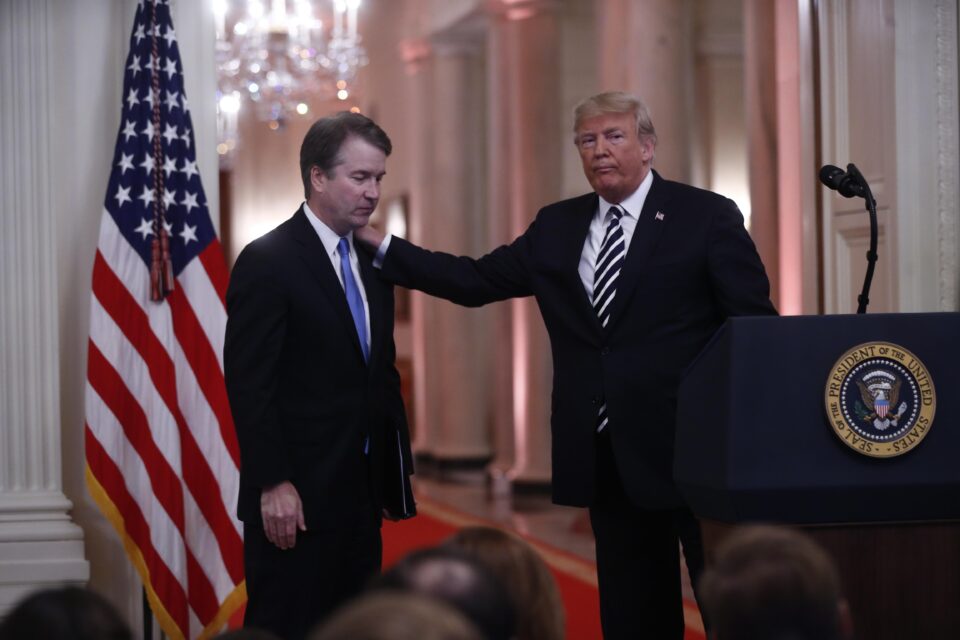
US President Donald Trump, right, greets Brett Kavanaugh, associate justice of the US Supreme Court, during a ceremonial swearing-in event in the East Room of the White House in Washington, DC. | Andrew Harrer/Bloomberg via Getty Images
There is no question in US law that is clearly or more firmly settled than the question of whether people born in the United States are citizens of this country. The Fourteenth Amendment states that “all persons born or naturalized in the United States, and subject to the jurisdiction thereof, are citizens of the United States.”
“All persons” means all persons. And, as the Supreme Court reaffirmed on Tuesday, the amendment’s limited exception for people not “subject to the jurisdiction” of the United States refers only to the small subset of people, like the children of ambassadors, who are not bound by US law at all.
And yet, the decision upholding birthright citizenship, known as Trump v. Barbara, was only 5-4 — a shocking near-miss that leaves the door open to further challenges if future appointees pull the Supreme Court the right.
It’s notable that a total of six justices did vote against President Donald Trump. While Justice Brett Kavanaugh made the extraordinary claim that the Constitution’s meaning has changed because “significant illegal immigration into the United States is a new circumstance that was largely unknown as of 1868,” he ultimately concluded that a federal statute prevents Trump from cancelling people’s citizenship.
Still, that’s four votes against reading the Constitution according to its unambiguous text. And it’s four votes for overruling a Supreme Court opinion that’s been on the books since the 19th century.
Barbara is the most alarming decision that the Court has handed down since it declared that Trump is allowed to commit crimes in 2024. And, if not for the Trump immunity decision, the dissenting justices’ opinions in Barbara would be the gravest judicial attack on the rule of law since the Court upheld Japanese internment in Korematsu v. United States (1944).
And that means that, if Donald Trump gets to replace just one member of the Barbara majority, the United States enters a very dark place.
The majority opinion in Barbara is a straightforward application of existing law
When Judge John Coughenour, a Reagan appointee who was the first judge to block President Donald Trump’s attempt to strip citizenship from many Americans born in this country, announced that decision, he said that he’s “been on the bench for over four decades” and he “can’t remember another case where the question presented is as clear as this one is.”
It’s not just that the Constitution is clear. The Supreme Court also held more than a century ago, in United States v. Wong Kim Ark (1898), that the Constitution means what it says. The question in Barbara, which was whether Trump can simply cancel the citizenship of people born in the US, may be the easiest question that has reached the justices in anyone’s lifetime.
The majority opinion in Barbara was authored by Chief Justice John Roberts and joined by all three of his Democratic colleagues, plus Justice Amy Coney Barrett. It is fairly short, clocking in at 26 pages, and it faithfully recites this orthodox view of the Fourteenth Amendment and its history.
As Roberts explains, early US citizenship rules derived from the English common law, which held that children born within the King’s “dominions” were “natural-born subject[s]” of that King and thus were citizens. This rule prevailed in the United States until the Supreme Court’s “odious decision” in Dred Scott v. Sandford (1857) held that “all those descended from slaves” were not citizens.
The Fourteenth Amendment was enacted in large part to overrule Dred Scott and to restore the English rule. And what of the amendment’s exception for persons not “subject to the jurisdiction” of the United States? Roberts explains that this means that any “child born on American soil and subject to American law was made an American citizen.”
All of this merely summarizes the same conclusion the Court reached nearly 130 years ago in Wong Kim Ark, which held that a man born to Chinese citizens on US soil was a citizen of the United States. Wong Kim Ark also laid out the modern understanding of the words “subject to the jurisdiction.”
In modern America, this category includes children of foreign diplomats who enjoy diplomatic immunity from US law, as well as the children of soldiers in invading armies. When Wong Kim Ark was decided, it also included many Native Americans — on the theory that these individuals were citizens of their tribal nation and thus a degree removed from US law — although a 1924 law established that tribal citizens are also US citizens.
So that’s what the law has been since the Fourteenth Amendment was ratified in 1868, and it’s how the Supreme Court has understood the law since at least 1898. And, despite Kavanaugh’s claim that an uptick in immigration has changed the meaning of the Constitution, nothing in the Fourteenth Amendment has changed since then.
So how did this case wind up with a dissent?
While Kavanaugh makes the idiosyncratic claim that the Constitution’s meaning can change depending on how many people immigrate to US soil, the primary dissent, which is authored by Justice Clarence Thomas, relies largely on a theory first advanced by (and later abandoned by) white supremacists in the years prior to Wong Kim Ark.
Briefly, Thomas claims that the Fourteenth Amendment’s citizenship provision applies only to the children of people who are “domiciled” in the US and not to the children of “temporary visitors.” This theory has no basis in the text of the Constitution, which, again, refers to “jurisdiction” and not domicile.
Notably, however, this claim that domicile — a legal term which refers to the intention to remain indefinitely in a particular place — controls citizenship does have an historical pedigree. It is also featured heavily in Trump’s briefs attempting to justify his attempt to cancel people’s citizenship. (Justice Neil Gorsuch, for what it’s worth, joins Thomas’s opinion but also suggests that “children born in this country to parents who make their permanent home here” are citizens, which could include children of undocumented immigrants. That attempt to carve out just these children also has no basis in the Constitution’s text.)
In an 1881 book that Trump’s lawyers quote in their brief, the white supremacist lawyer Alexander Porter Morse — the same lawyer who would go on to successfully argue in favor of segregation in Plessy v. Fergusson (1896) — claimed that the Fourteenth Amendment should be read to deny citizenship to “children of foreigners transiently within the United States.”
Interestingly, Morse appears to have abandoned this theory of the Fourteenth Amendment in a speech he gave to the American Bar Association just three years after the publication of his 1881 treatise. In the three intervening years, courts largely rejected Morse’s reading of the amendment, so Morse moved on to other arguments that were more likely to persuade judges. (Those new arguments, of course, did not persuade the Supreme Court in Wong Kim Ark.)
So here we are today, with several justices arguing that the Constitution has been misinterpreted for the last 130 years and that the correct reading is one that white supremacists briefly embraced in the 1880s and then abandoned once they proved unpersuasive to 19th century judges.
A justice who would prefer the discarded views of a long-dead white supremacist is one hell of a chaos agent to add to the Supreme Court. But now we have several of them, plus Kavanaugh, who apparently believes that constitutional rights can simply disappear if too many immigrants show up.
The one silver lining in all of this is that, for now, there is a five justice majority for the proposition that the Constitution means what it says. But, if Trump gets to replace just one member of that majority, every provision of the Constitution is potentially in danger.
previous post
